Importers must ensure that radio equipment which they intend to place on the Irish market meets the essential requirements of the Radio Equipment Directive (“RED”) (see Article 3 of 2014/53/EU).
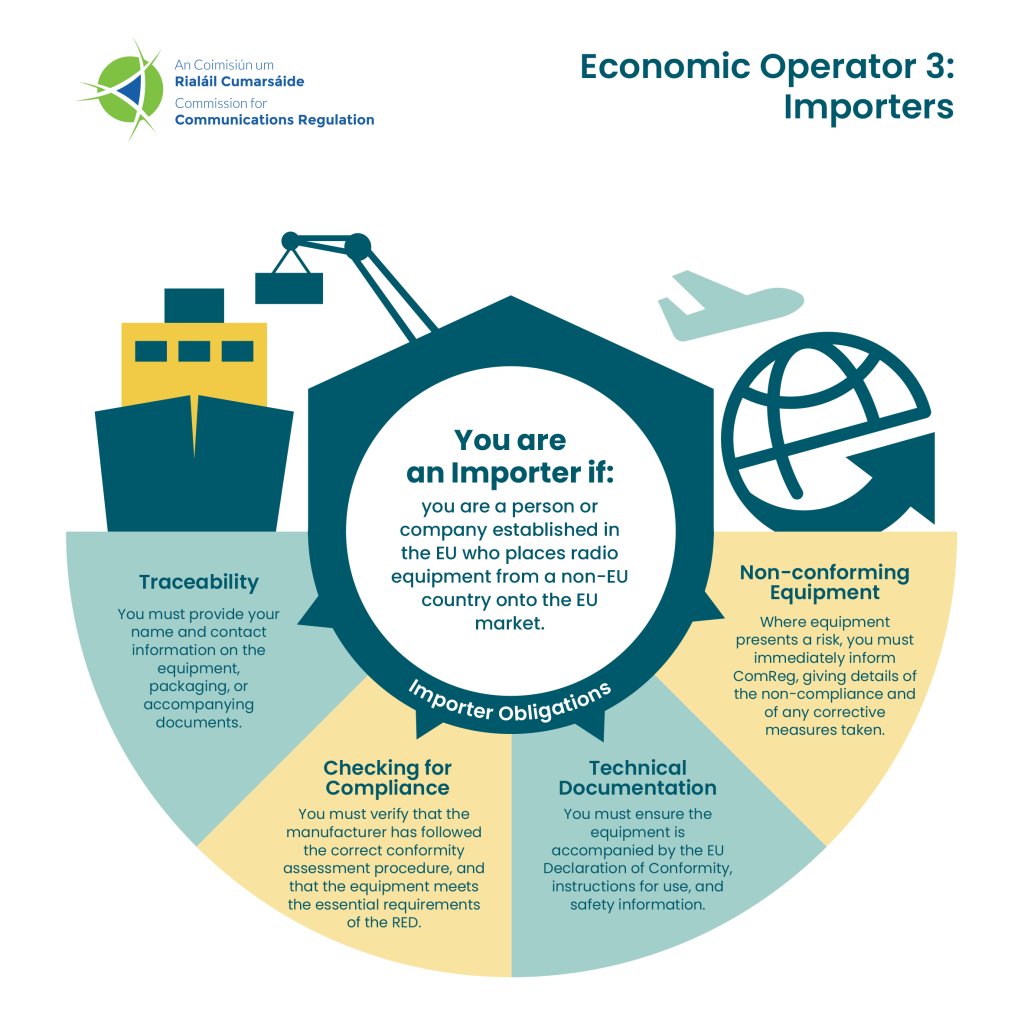
For the purposes of Article 4 of the Market Surveillance Regulations (Regulation 2019/1020) an importer is a person or a company established in the EU who places radio equipment from a non-EU country onto the EU market. Where an online marketplace is also an importer, Article 4 can still apply.
Under Article 4, the name (or registered name/trademark) and contact details (including postal address) of the economic operator must be indicated on at least one of the following:
- The product
- Its packaging (i.e. the sales packaging)
- The parcel (packaging to facilitate handling and transport)
- An accompanying document (e.g. declaration of conformity)
Importers must only place compliant radio equipment on the market. The importer must ensure that equipment has the appropriate conformity assessment procedure (referred to in Article 17 of the RED) carried out by the manufacturer.
Further, importers must ensure that the radio equipment is accompanied by instructions and safety information in a language which can be easily understood by consumers and other end-users. If an importer regards an item of radio equipment to present a risk to the health and safety of end users, they must:
- Carry out sample testing of that equipment;
- Investigate and keep a register of complaints relating to non-conforming radio equipment and radio equipment recalls (whilst keeping distributors informed of any such monitoring); and
- Cooperate with ComReg, at ComReg’s request, on any action taken to eliminate the risks posed by the radio equipment which the importer has placed on the market.
Radio equipment is defined as any electrical or electronic product that intentionally emits or receives radio waves for communication or radiodetermination or requires an accessory (such as an antenna) to do so. Examples of radio equipment are GPS trackers, smart watches, Bluetooth and WiFi-enabled devices, smart kitchen and home appliances, baby monitors, phones, and laptops.
ComReg, as the sole Market Surveillance Authority in Ireland for the RED, conducts inspections of radio equipment for sale in Ireland, to check for compliance and ensure that the essential requirements of the RED are being met.
These inspections include:
- Checking that an EU Declaration of Conformity accompanies the radio equipment;
- Checking for the presence of the CE mark, which must be visible, legible, and indelibly affixed;
- Checking that the radio equipment is clearly marked with a type, batch, or serial number, as well as the manufacturer’s contact details;
- Checking that each item of radio equipment is accompanied by instructions for user and safety information in the correct language; and
- If the manufacturer is based in a third country, checking that there is an Economic Operator in the EU (an EU Authorised Representative) to represent them.
Find out more on the Economic Operators page.