SMS Sender ID Registry
This page contains:
Update on SMS Sender ID Blocking, 19 September 2025
Latest update on ComReg’s SMS Sender ID Processing
Background
How SMS text messages have changed
Organisations using SMS Sender IDs must register now
Information for SMS Providers (Mobile Service Providers and SMS Aggregators)
What is an SMS Sender ID?
What is the SMS Sender ID Registry?
Registry Q&A

To prevent modification of your Sender ID, check with your SMS Provider (OPA) about any additional registration processes for you to take that go beyond the ComReg registration.
Under no circumstances can Participating Aggregators introduce additional verification (or require other unnecessary customer self-care) steps into their processes which serve to hinder the full implementation of Decision Instrument D14/24.



Update on SMS Sender ID Blocking, 19 September 2025
Since 3 July 2025, SMS text messages sent from unregistered SMS Sender IDs have been modified to ‘Likely Scam’. This was done to inform and protect the public from potential text scams, in accordance with ComReg’s Decision D14/24.
Since then, ComReg has worked closely with industry parties to resolve technical issues they were facing on their systems. While the majority have resolved their issues, ComReg continues to work with a number of industry parties who still have issues.
The blocking of Application-to-Person (A2P) SMS messages from unregistered Sender IDs was scheduled to commence on 3 October 2025. Given the above, there is a potential but avoidable risk for consumers if industry was to advance to the next step at this time.
Therefore, and out of an abundance of caution, ComReg will defer the commencement of the blocking phase, thereby maintaining the ‘Likely Scam’ modification requirement, until it can be satisfied that the outstanding issues are resolved. Further details on the deferral of the blocking phase can be found here.
Latest update on ComReg’s SMS Sender ID Processing
26 March 2026:
- Number of Registered SMS Sender IDs: 20,029
- Number of Registered SMS Sender ID Owners: 14,781
Background
SMS is widely accessible allowing mobile phone users to send and receive text messages. In 2024, 2.3 billion texts were sent in Ireland, with an estimated 615 million being Application-To-Person (A2P) messages.
SMS scams are eroding trust in SMS communications. Europe Economics estimates the quantifiable harm to consumer and businesses in Ireland from scam texts is approximately €115 million per year.
How SMS text messages have changed
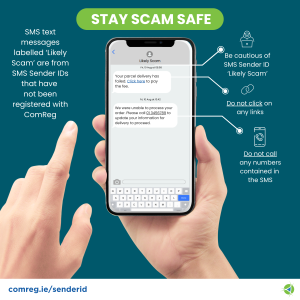
Since 3 July 2025, SMS text messages sent from unregistered Sender IDs are labelled ‘Likely Scam’ to protect consumers from potential scams.
Stay scam safe – be cautious of the content of ‘Likely Scam’ text messages:
- Do not click on any links contained in the SMS text message
- Do not call any numbers contained in the SMS text message
- Check organisations’ contact details separately e.g., by doing a web search
ComReg also advises the public to remain vigilant and prudent for all SMS it receives and avoid using URLs provided in the SMS or providing personal information, such as bank details, PPS numbers, or credit card details, over the phone.
SMS text messages labelled ‘Likely Scam’ may be from legitimate businesses or organisations who have not yet registered their Sender ID with ComReg, or they could be actual scam messages. We are aware that some already registered Sender IDs are being modified to “Likely Scam”. Please be advised that we are working with the Mobile Service Providers and SMS Providers to resolve this issue as soon as possible.
Organisations using SMS Sender IDs must register now
Organisations using SMS Sender IDs in their SMS text messages to mobile phone users in Ireland must register their SMS Sender IDs with ComReg now.
Organisations may register their own SMS Sender ID, or their SMS provider may register the SMS Sender ID on their behalf.
Thousands of SMS Sender IDs are already registered, and organisations can check the status of their SMS Sender ID here.
If your SMS Sender ID is not registered, act quickly and register directly here.
To send SMS text messages from new Sender IDs, you must also register those new Sender IDs with ComReg.
ComReg aims to process Sender ID applications as quickly as possible. However, applicants should be aware that newly registered Sender IDs may be modified to ‘Likely Scam’ until they are activated by all SMS providers.
SMS text messages from unregistered SMS Sender IDs will be blocked at a later date, and those messages will not reach the recipient.
Information for SMS Providers (Mobile Service Providers and SMS Aggregators)
Inform your customers that all SMS Sender IDs for A2P text messages to mobile users in Ireland must now be registered with ComReg.
If your SIDO customers have any additional processes to follow, please make sure they know what to do. Under no circumstances can Participating Aggregators introduce additional verification (or require other unnecessary customer self-care) steps into their processes which serve to hinder the full implementation of Decision Instrument D14/24.
MSPs and Participating Aggregators may register SMS Sender IDs on behalf of their customers’ organisations.
What is an SMS Sender ID?
Many organisations rely on Application-To-Person (A2P) SMS text messaging to communicate with their customers, clients and members.
A2P SMS messages often include an alphanumeric originating address (e.g., 234BANK) to indicate who sent the message – this is called the SMS Sender ID. SMS Sender IDs differ from phone numbers as they also include letters and/or permitted characters (e.g., space, hyphen, comma).

What is the SMS Sender ID Registry?
ComReg has introduced the SMS Sender ID Registry (Registry) to help prevent scam SMS messages.
The Registry is a secure repository of registered SMS Sender IDs, registered Sender ID Owners (SIDOs), Participating Mobile Service Providers (MSPs) and Participating Aggregators (PAs). Participants must adhere to the rules of operation of the Registry.
Please note, the Registry is only for registering alphanumeric Sender IDs. Certain numeric-only Short Codes may be registered as Sender IDs by the holder of those Short Codes (3-digit emergency Short Codes – 112 and 999, 4-digit Customer Support Short Codes in the format 19XX, 5-digit Messaging and Payment Short Codes in the format 5XXXX and 6-digit Short Codes for Harmonised European Services of Social Value in the format 116XXX).
You do not need to register your mobile phone number.
Registry Q&A
This Q&A section is provided to assist the users of the Registry.