Radio equipment is defined as any electrical or electronic product that intentionally emits or receives radio waves for communication or radiodetermination or requires an accessory (such as an antenna) to do so. Examples of radio equipment are GPS trackers, smart watches, Bluetooth and Wi-Fi-enabled devices, smart kitchen and home appliances, baby monitors, phones, and laptops.
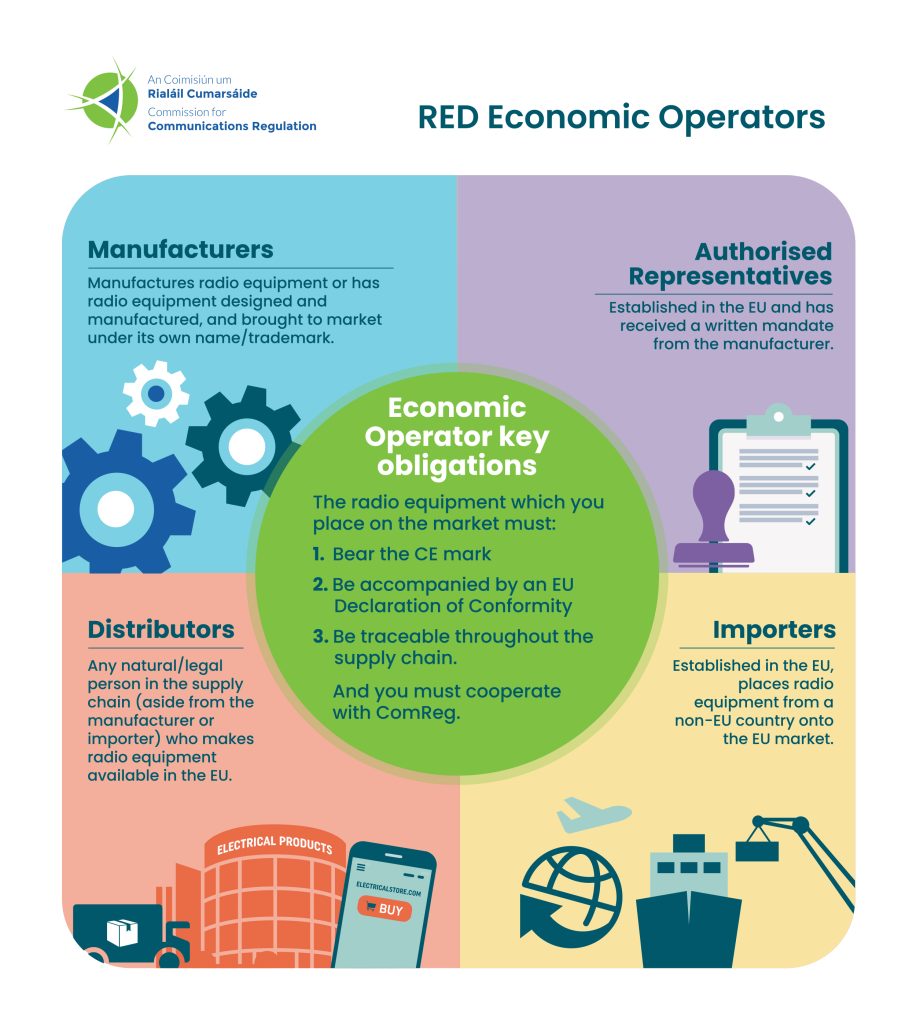
Economic Operators are manufacturers, authorised representatives, importers, distributors, or a person that is part of the product supply chain.
Typically, in this case:
- The manufacturer is responsible for the conformity assessment of the product and is subject to a series of obligations including traceability requirements;
- The manufacturer may appoint an authorised representative, via a written mandate, in the European Union to act on their behalf in carrying out certain tasks;
- The importer is a natural or legal person established in the Union who places a product from a third country on the EU market. Their obligations build on the obligations of the manufacturer; and
- The distributor is a natural or a legal person in the supply chain, other than the manufacturer or the importer, who makes a product available on the market. This includes high street retailers and e-commerce platforms.
Before manufacturing, importing, or purchasing equipment or devices, Economic Operators must ensure that this equipment or devices can be used in conformity with EU and Irish law. In Ireland, ComReg is the designated Market Surveillance Authority in respect of the Radio Equipment Directive 2014/53/EU (RED). The RED is transposed into Irish law by way of the European Union (Radio Equipment) Regulations 2017 (S.I. No. 248/2017) (RE Regulations), which establishes a regulatory framework for placing radio equipment on the market.
Economic Operator Key Obligations
Economic Operators must ensure that the radio equipment which they place on the market:
- Bears the CE mark
- Is accompanied by an EU Declaration of Conformity
- Is traceable throughout the supply chain
Further, if an Economic Operator has reason to the believe that the radio equipment which they have made available on the market presents a risk to the health and safety of End-Users, they must:
- Make sure that the corrective measures necessary to bring the radio equipment into conformity are taken (this can include a product recall or withdrawal);
- Immediately inform ComReg, giving details in particular of the non-compliance and of any corrective measures taken; and
- Cooperate with ComReg, at ComReg’s request, on any action taken to eliminate the risks posed by the radio equipment which has been placed on the market.
ComReg’s Role
ComReg engages in market surveillance activities such as:
- Investigating complaints from product End-Users and industry about unsafe products;
- Working with Customs to minimise non-compliant products from entering the Irish market;
- Monitoring e-commerce platforms to ensure that products are safe and compliant;
- Inspecting retail outlets to ensure that products on sale are safe and compliant;
- Making information on product safety available to manufacturers, authorised representatives, importers, and distributors so that all fully understand and are aware of their obligations;
- Ensuring end-users are aware of unsafe products; and
- Updating the EU product safety alert systems, Safety Gate and ICSMS.
For further information about the obligations of Economic Operators and how to meet these obligations, visit www.comreg.ie/productsafety