Radio Interference
Radio Interference Investigation
ComReg’s Spectrum Intelligence and Investigations unit investigates cases of radio interference. Interference can affect any radio service, including but not limited to, emergency services, air traffic control, mobile phone services, business radio, microwave links and broadcast services.
Unintentional interference can be caused by incorrectly or poorly installed radio systems and by faulty or non-compliant electrical or electronic equipment. Unlawful devices, such as mobile phone repeaters are a common source of interference. Any electrical or electronic device has the potential to be a source of radio interference given the right circumstances.
General Public
Where a member of the public believes that their, broadband or mobile phone service is experiencing radio interference this should be reported to the service provider. If the service provider determines that an external interference issue is occurring, it will contact Spectrum Intelligence and Investigations directly by submitting a case of suspected interference. In such cases Spectrum Intelligence and Investigations can only deal with the network operator and updates cannot be provided to third parties or members of the public.
Where a member of the public is experiencing disruption to Saorview or satellite television reception, a television reception system installer should check the installation for faults. System faults such as damaged cables & aerials are common sources of disruption to reception. Should it be determined that the disruption is caused by external interference, this should then be reported to Spectrum Intelligence and Investigations directly by submitting a case of suspected interference via the case report form.
RFI Complaint Classification Process
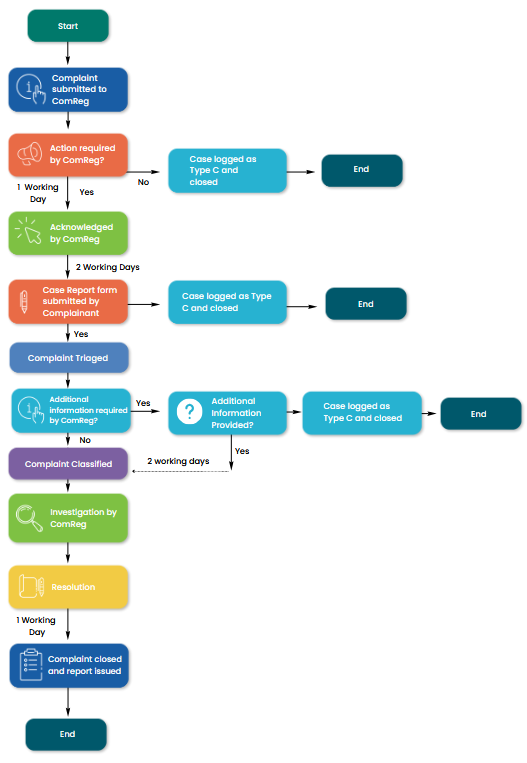
The below sets out the RFI complaint classification system and associated response times, along with a flowchart that illustrates the RFI complaint handling process.
Type A cases (Response time – Immediate)
Type A category would generally be exceptional in nature. Typically, such cases would have a severe impact on an operator’s ability to continue to provide a radio communications service and may result in a complete loss of service to users.
Cases falling into this category would need to fit the following general description:
- Depending on the type of radio communications service being provided there would need to be multiple stations experiencing interference simultaneously; and
- The licensee would have no alternative back up channel to switch its service to and
- Large numbers of users would need to be experiencing loss of service.
Examples of Type A cases could include:
- Instances where multiple TV and radio broadcasting transmitters are experiencing harmful interference such that it is not possible to provide any service to a large number of users.
- Harmful interference to a number of base stations on a mobile network such that significant numbers of users are unable to use their mobile phones
- Aeronautical or emergency services are interfered with to such an extent that it is impossible for any communications service to be provided to the end user. This may result in the grounding or redirection of aircraft in the case of aeronautical interference.
Type B cases (Response time – 5 working days)
Type B cases would typically have the following general description:
- Depending on the type of radio communications service being provided there would generally be one or two stations experiencing interference: and
- The licensee would have an alternative back-up channel to switch its service to; and
- Relatively small number of users would be experiencing loss or degradation of service.
Examples of Type B cases could include:
- Instances where a radio link is experiencing harmful interference such that it cannot operate as licensed;
- Harmful interference to a base station on a mobile network such that a single sector of the base station has to be turned off; and
- Harmful interference to a base station such that there is a degradation in the quality of service being provided to the end users.
Type C matters
Matters falling under Type C would typically be queries of the following types:
- Questions submitted to ComReg that can be respond to and addressed without recording as a formal complaint.
- Those cases of harmful interference submitted to ComReg where, due to the nature of the service provided, the complainant is not entitled to any protection from harmful interference by ComReg or is outside of ComReg’s remit.
- Those cases of harmful interference submitted to ComReg where the complainant does not provide sufficient information for ComReg to be able to properly evaluate the complaint.
Response times
Response time means the time taken, from receipt of all the required information from the complainant, to ComReg, or its agents, being deployed into the field to investigate the cause of interference. The response time is on the basis that the complainant makes engineering staff available to assist ComReg on site. If a complainant cancels or fails to attend a pre-arranged site visit, the period from cancellation or non-attendance, to ComReg or its agent’s site visit, along with the time required to reschedule a site visit, will not be counted as part of the response time.
Close out process
Once an interference complaint has been resolved by ComReg or its agent(s), the following steps will be taken:
- Contact will be made with the complainant outlining a summary of onsite findings including the source of the interference, this may include screenshots showing the absence of interference on the channel concerned. In cases where a prosecution may be likely to be taken the details of interference will not be disclosed.
- An outline of any actions that must be taken by complainant in order to remedy the situation will be given in an email; and
- An acknowledgement that the case has been closed will be sent to the complainant with the corresponding case number.